Emerging Global Asian Equity Funds: Unlocking Investment Potential in Asia's High-Growth Economies
Australia’s domestic equity market accounts for just 2% of global market capitalisation, limiting home-grown growth opportunities. The Asia-Pacific region now hosts 55% of all publicly listed companies worldwide (vs. 20% in the Americas and 25% in EMEA) and represents roughly one third of total global market capitalisation as of 2025. Emerging markets, including many of Asia’s high-growth economies, comprise about 27% of the global equity market.
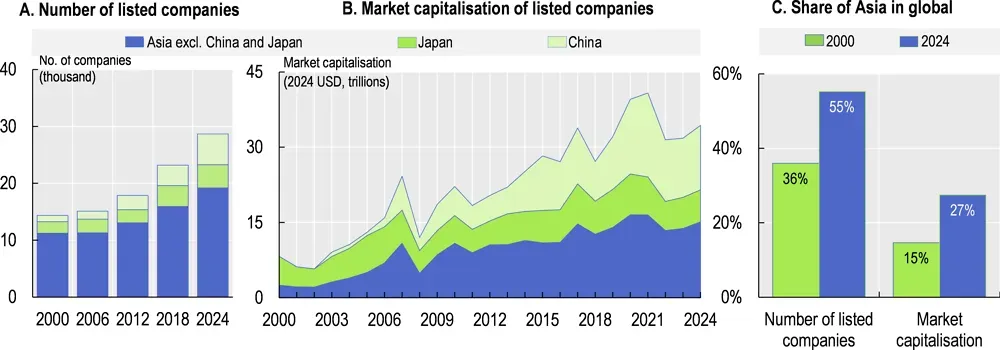
Source: OECD
In the words of Elizabeth Soon from PineBridge Investments:
‘Asia continues to offer compelling investment potential, benefiting from various opportunity sets across the region. China is shifting from a manufacturer of low-end goods to being a high-end technology producer. Companies are also going global, which leads to the creation of multinational Chinese corporations.'
Asia is expected to be a main driver of global economic growth as described by Krishna Srinivasan, IMF director:
‘(it’s) contributing 60 percent to global growth, is clearly the powerhouse of the global economy.’
How Australian investors can effectively access Asia’s growth markets
Emerging Global Asian Equity Funds and ETFs provide easy and convenient access to the Asian investment opportunity. They are professionally managed, diversified investment vehicles designed to manage currency, political, and market volatility risks on behalf of investors.
They offer exposure to developed economies, like Singapore and Hong Kong, as well as rapidly growing emerging markets, including China, India, Taiwan, South Korea, and ASEAN nations.
Emerging Global Asian Equity Funds & Essential Investment Concepts Explained
Emerging Global Asian Equity Funds are investment vehicles that pool capital from multiple investors to purchase shares in companies across Asia. These funds provide diversified exposure to Asia’s dynamic economies through professionally managed active portfolios aimed at outperforming, or by passively tracking regional indices such as the MSCI AC Asia Index with its exposure to 1,191 Asian stocks.
Australian investors are increasingly turning to Asian Equity Funds to tap into the region’s dynamic economic growth prospects, expanding middle class, and innovation-led industries. With Asia now accounting for a significant and rising share of global GDP, these funds are exposed to powerful structural growth drivers. The IMF expects emerging Asian economic growth to be 5% in 2025, significantly outpacing global growth of 3%. Diversification benefits are also a key attraction as Asian equities often move independently from Western markets.
Before we dive in, here’s a brief definition of some key terms Emerging Global Asian Equity Fund investors need to understand:
- What is an Emerging Market (EM)? Emerging Markets are countries experiencing rapid economic growth and industrialisation as they transition from ‘developing’ to ‘developed’.
- What is Asian Equity? Asian equity are shares in companies headquartered, listed, or deriving significant business operations from Asian markets, including both developed and emerging Asian economies.
- What are Growth Markets? Growth markets are economies characterised by above-average GDP expansion, rising middle-class consumption, and increasing urbanisation trends. India is a prime example.
- What are Asian Regional ETFs? These are investment funds that trade on stock exchanges like individual shares, while providing diversified exposure to multiple Asian securities across various countries and industry sectors.
Types of Emerging Global Asian Equity Funds
Emerging Global Asian Equity Funds cater to various strategies, with Australian providers including Antipodes, Allard, and GlobalX offering diverse options.
There are five main types of Emerging Global Asian Equity Funds worthy of investor’s consideration:
Managed Funds (Unlisted)
Traditional Asian Managed Funds can be accessed through direct applications with their fund managers, and often require a minimum investment (e.g. $10,000 - $25,000).
The professional managers of these funds select stocks with the objective of outperforming their benchmarks. They aim to leverage extensive on-ground research capabilities to identify outperforming stocks. Many fund managers possess a large network of research professionals based throughout Asia to identify local trends and opportunities.
For example, Traditional Asian Managed Funds like Allard Investment Fund aim to deliver strong long-term returns through a concentrated portfolio of 25-30 Chinese, Indian, and Indonesian stocks. This fund has delivered a 7.7% p.a. return since its inception, and charges a management fee of 1.25% p.a.
Exchange-Traded Funds (ETFs)
In contrast to the active approach of managed funds, ETFs aim to passively replicate the performance of a benchmark like MSCI AC Asia Index.
ETFs offer the diversification of a managed fund with the trading flexibility of a share on the ASX, and they generally charge lower fees than managed funds.
In the words of Covenant Wealth,
‘ETFs offer the advantage of more flexibility. You can buy and sell shares throughout the day at market prices which can be valuable if you want to react promptly to market changes. ETFs also generally (but not always) charge lower fees which, over the long run, can result in the potential for higher returns for your portfolio.’
Passive ETFs, which track broad indices, are the most common type of ETF.
Examples include the Vanguard FTSE Asia ex Japan Shares Index ETF (VAE) with management fees of 0.40% p.a., and the more focused BetaShares Asia Technology Tigers ETF (ASIA), which targets the 50 largest tech companies in Asia (ex-Japan) with management fees of 0.67% p.a.
Active ETFs, in contrast, feature professional management aimed at outperforming but are less common in the Australian market.
Currency Hedged vs Unhedged Options
Unhedged Funds like Global X India Nifty 50 ETF provide full exposure to currency movements, which can add to gains if the AUD weakens but detract from them if it strengthens.
Currency-Hedged funds use financial instruments to minimise the impact of AUD exchange rate fluctuations on investment returns, providing a return profile closer to the underlying assets' local performance.
Regional, Country, and Thematic Funds
Regional/Country Funds focus on specific areas like ASEAN, Greater China, or India. For example, Global X India Nifty 50 ETF invests in the fifty largest companies in India.
Sector/Thematic Funds target specific trends, such as technology innovation (e.g. Betashares Asia Technology Tigers ETF), financial services, or consumer discretionary sectors.
The decision between ETFs and managed funds is summarised by Covenant Wealth:
'Ultimately, the choice between ETFs and managed funds hinges on your financial goals, risk tolerance, and investment preferences.’
4 Benefits of Investing in Asian Equity Funds
Access to High-Growth Economies & Diversification
Asian Equity Funds provide direct exposure to some of the world’s fastest-growing and most populous economies. They also offer diversification benefits away from the more mature markets of Australia, the US, and Europe. The Asian region’s diverse mix of economies, ranging from developed hubs to dynamic emerging nations, provides multiple, and often uncorrelated, drivers of growth.
As Bill Maldonado, Chief Investment Officer at Eastspring Investments, explains:
‘Asia offers deep and well-developed markets as well as less mature markets, each presenting its own set of unique opportunities’.
For example, the Indian economy is benefitting from multiple structural drivers. Huzaifa Husain, Head of Indian Equities at PineBridge Investments, provides context:
‘India remains one of the fastest-growing countries, led by advancements in digitalisation, rising consumption potential, and energy transition initiatives.’
Technology & Innovation Leadership
Technology and innovation is a major theme for Asian companies. Asia is a global leader in innovation across semiconductors, e-commerce, fintech, and AI.
Asian Managed Funds and ETFs provide investors with access to the region’s globally significant companies at the forefront of digital transformation such as Taiwan Semiconductor, Tencent Holdings, and Samsung Electronics.
Favourable Demographics & Structural Tailwinds
Asia benefits from powerful long-term economic drivers, including a rapidly expanding middle class, increasing urbanisation, and rising consumption. Countries like India have strong structural growth prospects, while regional economies such as Malaysia and Indonesia offer attractive dividend yields for income-seeking investors.
According to Elizabeth Soon, CFA, Head of Asia ex-Japan Equities at PineBridge Investments:
‘Asia continues to offer compelling opportunities for equity investors, benefiting from a range of opportunity sets across the region.’
Access to Cheaper Valuations
Asian equity valuations are attractive versus developed markets.
According to Mike Shiao, Chief Investment Officer, Asia ex. Japan, Invesco:
‘Valuations across Asia equities remain compelling. Compared to developed markets, Asia trades at a meaningful discount, both on a relative basis and against its own historical averages. This valuation gap, combined with strong liquidity, especially in a weaker US dollar environment, offers an attractive entry point for long-term investors.’
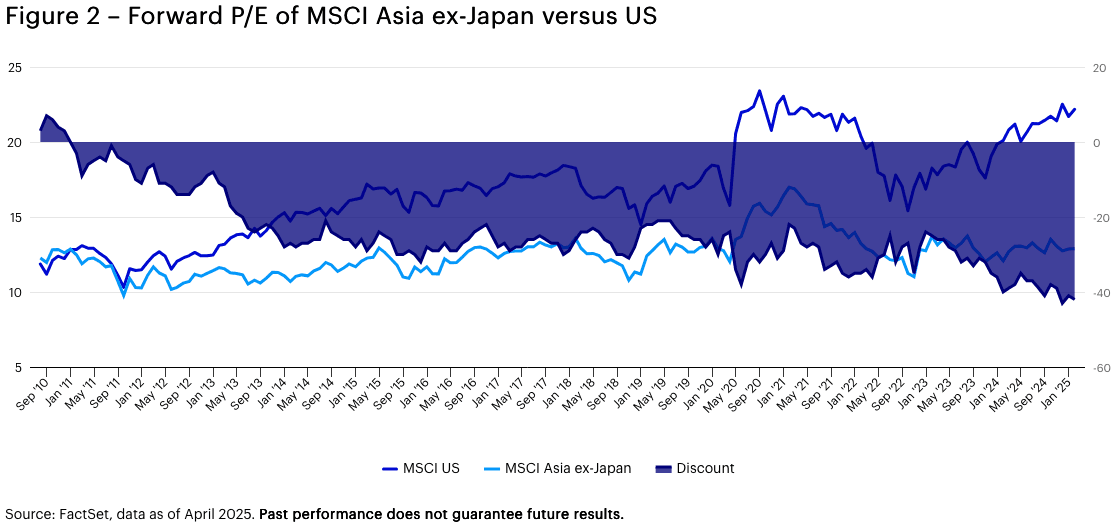
Source: Invesco
Risks and Challenges of Investing in Asian Equity Funds
While offering high growth potential, Asian Equity Funds also involve significant risks including:
- Currency Risk
Fluctuations between the Australian dollar and local Asian currencies can impact returns, especially in unhedged funds.
For example, for unhedged Asian Equity Funds a strengthening Australian Dollar (AUD) can erode their investment returns (and vice versa). - Political and Regulatory Risk
Markets like China and emerging Southeast Asian countries may face policy shifts, trade tensions, or regulatory crackdowns that affect investor confidence. - Liquidity Risk
Some Asian equities, particularly in emerging markets, may have lower trading volumes, making it harder to buy or sell positions quickly. - Corporate Governance
Governance standards can vary significantly across the region, with limited transparency, insider dealings, or weaker shareholder protections in some jurisdictions. - Market Volatility
Asian markets can be particularly sensitive to global economic shocks, local unrest, or speculative trading, leading to sharp price swings. - Information Asymmetry
Language barriers, limited analyst coverage, and varying disclosure standards may hinder effective research and decision-making for international investors. - Concentration Risk
Some Asian Funds may have significant exposure to specific sectors (e.g. tech or financials) or countries, increasing their vulnerability to localised or sector-specific downturns.
💡A Common Mistake to Avoid: Some investors assume all Asian markets carry the same risk profile. In reality, developed markets like Singapore and Hong Kong have a lower risk profile than emerging markets like Vietnam or Indonesia.
💡Pro Tip: Consider currency hedging based on your AUD outlook. In particular, if you expect AUD to strengthen, investing in currency hedged funds may preserve more of your underlying investment gains.
Who Should Consider Investing in Asian Equity Funds
Investing in Asian Equity Funds is generally best suited for individuals with a long-term investment horizon (5-7+ years) who can withstand periods of market volatility.
These funds are ideal for investors seeking:
- Higher economic growth potential than what is typically available in developed markets.
- Geographic diversification to complement a portfolio heavily weighted towards Australian, US, or European equities.
- Higher risk assets since emerging markets can experience sharper downturns than developed ones.
- Long term (5-7 years+) rather than short term opportunities.
5 Ways Australians Can Invest in Emerging Global Asian Equity Funds
- Through an Online Broker
Buying Asian Equity ETFs listed on the ASX is as simple as buying any other ASX-listed stock.
Compare stock trading platforms based on brokerage fees, research tools, and access to international markets. - Directly via a Fund Manager
For unlisted Managed Funds, you can apply directly through the manager’s website, which involves completing forms and meeting any minimum investment requirements. - Using Investment Platforms (Wraps)
These platforms offer access to a wide range of managed funds from different providers through a single account, simplifying the administration process. - Through a Financial Adviser
A financial adviser can provide personalised recommendations on fund selection, portfolio construction, and risk management. - Via Superannuation or SMSFs
Most super funds offer ‘International Shares’ or ‘Emerging Markets’ investment options. SMSFs can invest directly in ASX-listed Asian ETFs.
Tax Implications for Australian Investors Investing in Asian Equity Funds
Understanding tax is crucial for maximising investors’ net returns in Asian Equity Funds.
Here are a few important tax considerations:
- Foreign Income & Withholding Tax
Dividends from Asian companies are often subject to a withholding tax in their home country. Australian residents can typically claim a Foreign Income Tax Offset (FITO) to prevent double taxation.
According to the ATO: ‘You may be able to claim a foreign income tax offset (FITO) for foreign tax paid in another country. The offset provides relief from paying double tax.’ - Fund Structures
Both ETFs and Managed Funds should provide annual tax statements detailing the different fund return components (dividends, capital gains) and any foreign tax credits. - Capital Gains Tax (CGT)
Selling units in a Managed Fund or ETF for a profit will trigger a CGT event.
The 50% CGT discount is available for assets held longer than 12 months. - Record Keeping
It’s essential to keep detailed records of all transactions, distributions, and currency conversions for tax purposes. Professional tax advice is recommended.
💡Tax Trap: Failing to claim the Foreign Income Tax Offset (FITO) on your Asian Equity Fund income can result in double taxation.
💡Record-Keeping Tip: Maintain detailed records of all transactions, distributions, and currency conversions as the ATO requires comprehensive documentation for foreign investment claims.
4 Steps to Building, Managing, and Monitoring Your Asian Equity Fund Portfolio
- Define Goals & Allocation
Clarify your investment horizon, risk tolerance, and income or growth targets.
Determine your objective: is it broad diversification, thematic exposure to tech, or a specific country bet?
Your risk tolerance will define the appropriate allocation size within your global equity portfolio.
Asia’s markets range from emerging to developed, so your allocation should reflect your objectives and risk tolerance. - Use a Core-Satellite Approach
Anchor your portfolio with broad-based Asian ETFs (core) and complement them with high-conviction active funds or thematic plays (satellite). This provides a disciplined framework for combining passive efficiency with active opportunity.
For example, a popular strategy is to use a low-cost, broad-market Asian ETF (like VAE) as the ‘core’ (60-80% of the allocation) and to add smaller, more targeted ‘satellite’ positions in active funds like Antipodes Emerging Markets for potential outperformance.
Robin Parbrook and King Fuei Lee, portfolio managers of the Schroder Asian Total Return Investment Company, note: ‘One of the most effective ways of investing in Asian equities is to disregard the benchmark. The Asian equity opportunity set is large enough and diverse enough for investors to be extremely selective.’
- Monitor Key Performance Indicators (KPIs)
Once invested, investors should track their Fund and ETF KPIs, including:
💡Tip: Monitoring KPIs isn’t just about returns. It’s about staying aligned with your strategy. - Returns: Track total returns (capital growth plus distributions), and risk-adjusted returns using measures such as the Sharpe Ratio (the performance of a fund/ETF compared to a risk-free asset, after adjusting for its risk) for a holistic view of returns.
- Benchmark Comparison: Compare your fund’s performance against its stated benchmark (e.g. MSCI AC Asia Index), including its sector or country exposures. For ETFs, follow their tracking error versus their chosen benchmarks.
- Portfolio Reports: Review fund manager reports for commentary on performance, holdings, and outlook.
- Rebalancing & Review
Reviewing your portfolio quarterly or semi-annually is an important step.
If you identify that your portfolio has moved away from your target weightings, rebalancing can be prudent. It enforces discipline, helping investors avoid chasing short-term trends.
For example, rebalance by trimming winners or adding to underperformers if your target allocations have drifted significantly. This enforces a ‘buy low, sell high’ discipline. Adjustment triggers could be time-based (e.g. every 6 months) or based on allocation thresholds (e.g. if a holding deviates by more than 5%).
Investor Checklist for How to Compare and Select an Asian Equity Fund
Once you’re ready to compare and select Asian Equity Funds, it’s time to take action.
Use this checklist to apply the knowledge from this guide and make an informed choice on investing in Asian funds and ETFs…
- Define your investment goals and time horizon.
- Assess your risk tolerance.
- Choose between active funds and ETFs.
- Decide on your regional focus (e.g. Asia-wide, China-only, emerging Asia).
- Use InvestmentMarkets to find funds which align with your goals.
- Compare fund and ETF performance over 3, 5, and 10 years with the help of websites like InvestmentMarkets. Look for performance consistency, not just short-term wins.
- Compare each prospective fund’s Management Expense Ratio (MER) and consider any brokerage costs for ETFs. Is the potential for active outperformance worth the higher fee?
- Check each prospective fund’s currency exposure (hedged vs unhedged).
- Review each prospective fund’s top holdings and sector allocations.
- Understand each prospective fund’s liquidity and exit terms.
- Consider the tax implications of investing, including withholding tax.
- Ensure each prospective fund is registered for Australian investors.
- Read each prospective fund’s PDS and product disclosure documents carefully.
- If you have any outstanding questions, ask the fund manager. And when in doubt, don’t invest.
Are Emerging Global Asian Equity Funds Right for You?
Emerging Global Asian Equity Funds offer a compelling pathway to participate in the world’s main economic growth engine while diversifying your portfolio beyond developed markets. With investment structures ranging from low-cost index ETFs to specialist active funds, there’s a suitable option for most investors.
The potential for superior long-term returns is driven by Asia’s powerful demographics, as well as its technological and economic tailwinds. However, this potential comes with higher risks, including currency volatility and political uncertainty.
A successful investment in Asian Managed Funds and ETFs depends on aligning your fund choice with a long-term timeframe, a suitable risk tolerance, and clear diversification goals. By using a disciplined approach to fund selection and portfolio management, Asian Equity Funds can form a powerful return driver within a well-rounded global investment strategy.