

Invest in robotics, automation and artificial intelligence.
Objective
Growth
Category
ETFs
Min. Investment
$500
Liquidity
Listed
Availability
Open for investment
Funding Stage
Listed
Structure
ETF
There’s some sobering news to report. Despite being one of the world’s richest nations in personal wealth terms, Australia has slipped to 105th out of 145 countries in Harvard University’s Economic Complexity Index (ECI).
The ECI measures how diverse and advanced a country’s export base is. High complexity is associated with innovation, strong manufacturing, and future growth resilience. Australia’s position, behind Botswana and just ahead of Côte d’Ivoire, reflects its narrow export profile dominated by unprocessed (read: low value-add) resources like iron ore, coal, and lithium.
A decade ago, Australia was already struggling at 93rd position in the ECI. Unfortunately, the situation has worsened with another twelve places dropped since then. This is a deep-set, multi-generational problem which requires a focused, long-term political response.
In the meantime, the challenge for investors is to insulate their portfolios against Australia’s growing economic vulnerabilities...
Search and compare a purposely broad range of investments and connect directly with product issuers.
Australia’s weak and deteriorating economic complexity surely spells longer term economic growth challenges. In a world increasingly defined by competitive rather than comparative advantages, world-leading innovation and manufacturing expertise has never been more valuable.
Whilst this is a concerning situation for the country, from investors’ perspectives there are ways to navigate it. Here are five strategies aimed at ensuring longer term portfolio resilience:
The Australian share market is heavily concentrated in banks and resource companies. With manufacturing representing just 5.1% of Australian GDP, the lowest in the OECD, local equity benchmarks lack breadth in higher-complexity sectors like technology, advanced manufacturing, and biotech. So diversifying globally has never been more important.
Investment Implications:
One of Australia’s greatest economic challenges is how little of the commodities value chain is retained locally.
For example, the country earns only 0.53% of the value of the lithium it exports (90% of which goes to China), despite producing half the world’s supply. Most downstream processing and manufacturing happens offshore, particularly in China.
‘The future is a world in which we have to develop sovereign capability in the production of these metals in order to participate on equal terms in global markets.’ University of Technology Sydney economist Roy Green
The key takeaway is that being conscious of where the economic value is created in the commodities production chain is of growing importance to investors.
Investment Implications:
While Australia’s ECI ranking has fallen, countries like Vietnam, Singapore, and India are climbing up the index. These markets are diversifying into electronics, pharmaceuticals, and advanced manufacturing, areas likely to see structural growth over the long-term.
Investment Implications:
Australia’s economy is sensitive to commodity cycles and housing market swings. Alternative asset funds and ETFs can help dampen the associated portfolio volatility.
Investment Implications:
Recent bailouts and co-investments in steel (Whyalla), smelting (Port Pirie, Hobart), and shipbuilding (Austal) mark a shift toward sovereign capability building. While picking winners at a company level is risky, investors can back broader sectors likely to benefit from policy support.
Investment Implications:
Ready to take aggressive portfolio action to avoid the longer term implications of Australia’s economic complexity deficit?
Here’s an aggressive globally-focused portfolio aimed at achieving the type of long term growth which may prove elusive in many parts of the local economy in the coming decades:
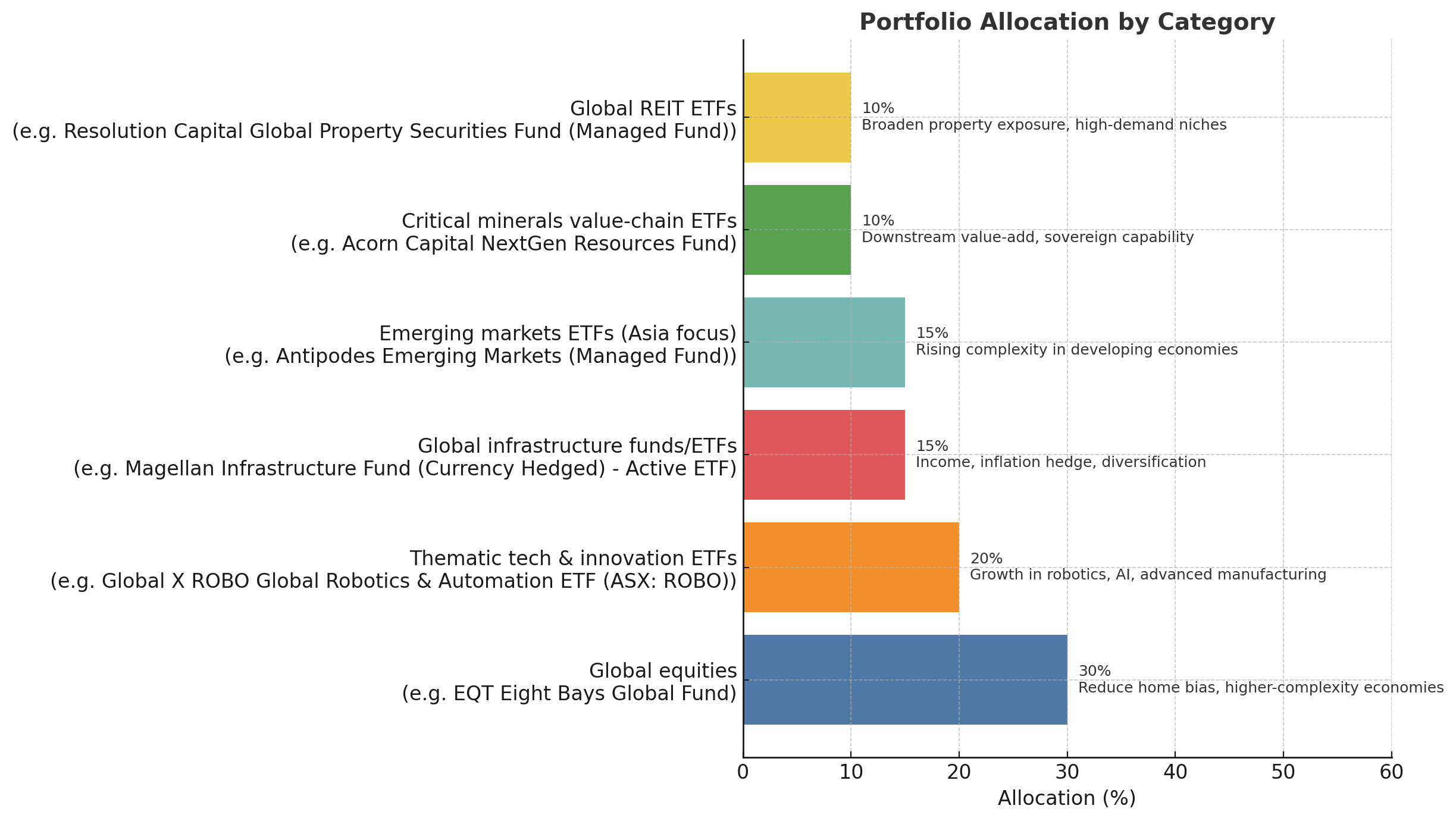
Australia’s decline in economic complexity isn’t just an abstract academic ranking. It’s a signal of a narrowing industrial base and growing vulnerability to external shocks. Whilst future policy shifts will hopefully slowly reverse this troublesome trend, investors need to adapt now.
Building a portfolio of global funds and ETFs that thrive despite a low-complexity domestic economy means thinking globally, embracing thematic growth in high-complexity economies and industries, and ensuring you have sufficient exposure to the sectors and geographies Australia currently lacks. It’s about building resilience against Australia’s growing economic vulnerabilities.
You don’t need to wait for the Australian economy to climb back up the economic complexity ladder for your portfolio to follow suit.
Click to watch EQT's Insight Series Podcast
Invest in robotics, automation and artificial intelligence.

The Fund objective is to achieve attractive risk adjusted returns over the medium to long-term while reducing the risk of permanent capital loss.

The Fund typically invests in a select number of attractively valued companies exposed to emerging markets or listed on emerging market stock exchanges (usually a minimum 30 long holdings).

The NextGen Resources Fund provides investors with exposure to a range of commodities such as lithium, the rare earth elements, graphite, nickel, gold, copper, oil, coking coal and gas. (For Wholesale Investors Only)
Disclaimer: This article is prepared by Simon Turner. It is for educational purposes only. While all reasonable care has been taken by the author in the preparation of this information, the author and InvestmentMarkets (Aust) Pty. Ltd. as publisher take no responsibility for any actions taken based on information contained herein or for any errors or omissions within it. Interested parties should seek independent professional advice prior to acting on any information presented. Please note past performance is not a reliable indicator of future performance.

-l7rg6lkopgoa2x6pxhua.png)
-8c4ntrkc5xpa1bncy14s.jpg)
-6gjpzrmfub3sdknjzdoy.jpg)
-v8lxc7275hr89z0hzkrz.png)
-ulhzagvbsmdk2tc72zgj.png)
-weh3swd4zyleexypgsv3.png)


